The Future of Growing is Happening Right Now at CSU
Building on the immense success of the FarmBot unveiled in 2023, hydroponics has emerged as the latest innovation—growing, quite literally, out of a practical limitation.
“We have been growing plants with the FarmBots for three seasons now, and they are wonderful educational tools, especially for our engineering students, and we plan to keep them in our repertoire of tech-enhanced gardening tools,” said Chris Rennison, director of academic technologies. “But they are largely designed for outdoor growing, and here in Cleveland, that means meaningful production tends to be limited to late spring through early fall.”
Hydroponics — growing plants without soil by feeding them nutrients dissolved in water — is transforming how we think about agriculture and food quality.
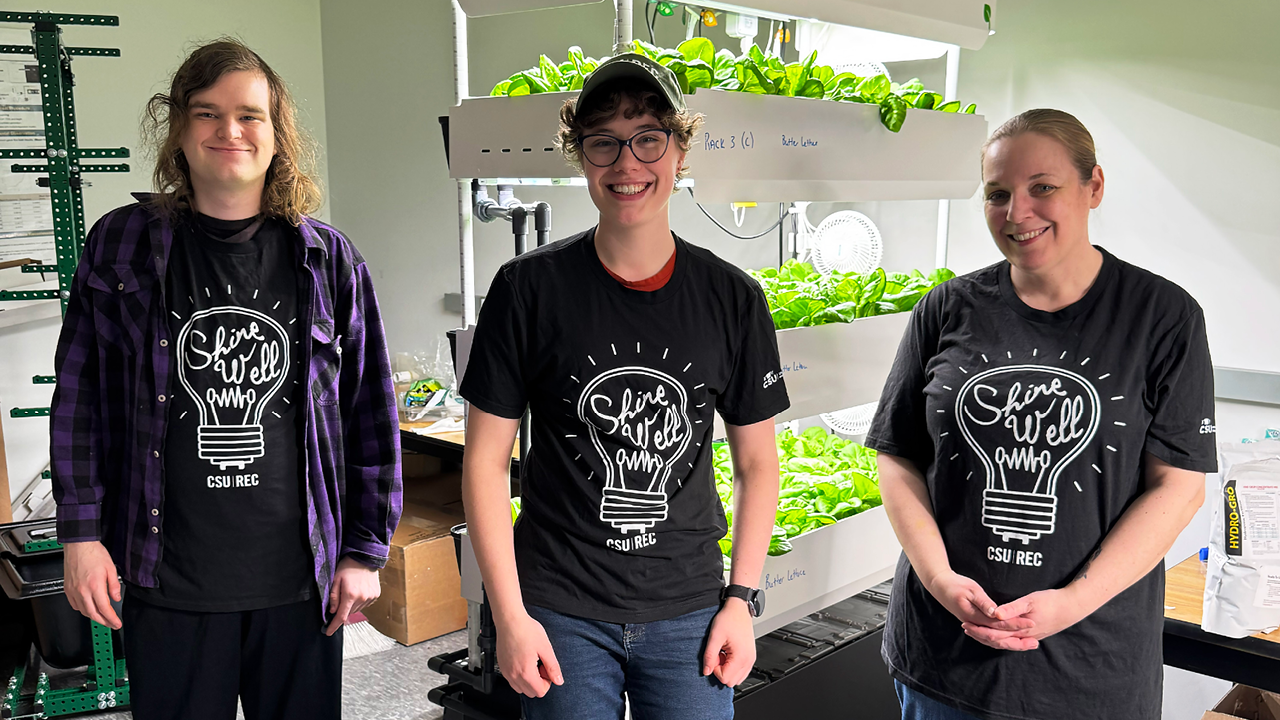
Cleveland State University students, faculty, staff and community partners are setting the gold standard by collaborating to grow fresh produce year-round using a new indoor hydroponics system housed in the College of Engineering.
Developed in partnership with CropKing, an Ohio-based manufacturer of greenhouse and hydroponic systems, the equipment gives students in the Washkewicz College of Engineering and the College of Health hands-on experience with technology used in the agricultural industry.
“Hydroponics offered several advantages: year-round production; controlled, indoor experimentation for research and teaching; and higher yield per square foot,” said Rennison. “That, in turn, led us to explore NFT systems vs. Bato bucket systems (for comparative research and production modeling), along with educational hydroponic racks. In short, the FarmBot gave us a powerful starting point, while hydroponics expanded the calendar of learning.”
UNDERGRADUATE RESEARCH AND EXTERNAL SUPPORT
The Connected Gardens team has received support from several funders over the years, including the President’s Office and the SHINE Well program. The most recent funding comes from the Ohio Space Grant Consortium’s Student-Innovative-Creative-Hands-on-Project (SICHOP) grant.
“This project directly supports SICHOP's goals of undergraduate-led, hands-on STEM research with outreach. It also fulfills CSU Engineering's capstone design requirements and offers a scalable impact on both education and sustainable agriculture research,” said Dr. Judy Ausherman, professor of health education. “Funding will enable equipment acquisition, experimentation, and engagement that lasts well beyond the project year.”
She added that it fits well with the senior design capstone project in the College of Engineering. Project results will be documented in a CSU-based urban agriculture open educational resource and will inform student-led agricultural innovation.
MORE THAN JUST A SCIENCE EXPERIMENT
When the FarmBot was constructed and installed by Tim Square, superintendent of grounds, and the CSU grounds team, one of its primary goals was to serve the CSU community through the Lift Up! Vikes food pantry. The pantry connects students with resources that supplement nutrition and other basic needs as they work toward earning a degree.
Coordinated by Katie Blodorn, assistant director of CSU’s Recreation Center, the program also included cooking demonstrations led by chef and CSU alumnus Jason Harbert of FoodStrong. Using ingredients from the pantry, Harbert showed students how herbs grown by the FarmBot can be incorporated into everyday cooking, connecting the technology behind the garden with practical, healthy meals.
Looking ahead, as the department builds on the success of FarmBot, the hydroponics program aims to create an educational lab that serves the learning needs of multiple colleges and departments.
Recently, senior design students Jamison Brennan, Grace Moon and Connor O’Brien harvested 64 heads of lettuce, which were donated to the Lift Up! Vikes food pantry. The program supports students while demonstrating interdisciplinary collaboration through technology, sustainability and community impact.
According to Rennison, the initiative represents an opportunity to build a strong platform for interdisciplinary education, where students, faculty and staff from engineering, technology, health and environmental science collaborate in a shared learning environment.
Ausherman added that hydroponically grown lettuce often tastes fresher and more flavorful than the lettuce sold at grocery stores. Grown in a carefully controlled environment and harvested at the right time, it keeps its crisp texture and clean, bright taste. Unlike store-bought lettuce, which may spend several days being shipped and sitting on shelves, hydroponic lettuce usually reaches people sooner after harvest, which helps it taste better.
Faculty advisor Toufik Aidja, who brings extensive experience with hydroponic growing systems, has guided the project and the students working with it. Hydroponic cultivation also produces more predictable yields. Because students can control the water, nutrients and light the plants receive, the lettuce is less affected by weather or poor soil conditions.
“This project gives students the opportunity to design, build and evaluate real hydroponic systems while collecting meaningful data on water use, energy consumption and crop performance,” said Aidja.
“By comparing EdRack, NFT and Bato systems, the team is not only advancing hands-on engineering education but also contributing practical insights into sustainable food production technologies.”
The bottom line? By integrating sustainable growing practices, smart agricultural technologies and health education, students can grow lettuce more consistently throughout the year, maintain a steady supply and cultivate food systems that nourish both the body and mind while fostering innovation, collaboration and a healthier future.